
Imagine moving collateral from Ethereum to Arbitrum, swapping one token for another, and then approving a lending contract. The transaction may look routine, yet several risks are compressed into a few clicks: the wrong network, an excessive token allowance, an unexpected contract interaction, or a bridge route that does not behave as expected. For users in Germany and elsewhere in the European DeFi community, this is the central wallet problem. Convenience reduces friction, but friction is sometimes the last moment at which a dangerous action can be reconsidered.
Rabby approaches that problem as a transaction-understanding tool rather than merely a key container. It is a non-custodial wallet developed by DeBank for Ethereum and other EVM-compatible networks, with a strong emphasis on simulation, security warnings, and multi-chain workflows. Its value is therefore not simply the number of supported chains. The more important question is whether the wallet helps users form a reasonably accurate expectation of what their signature will do.
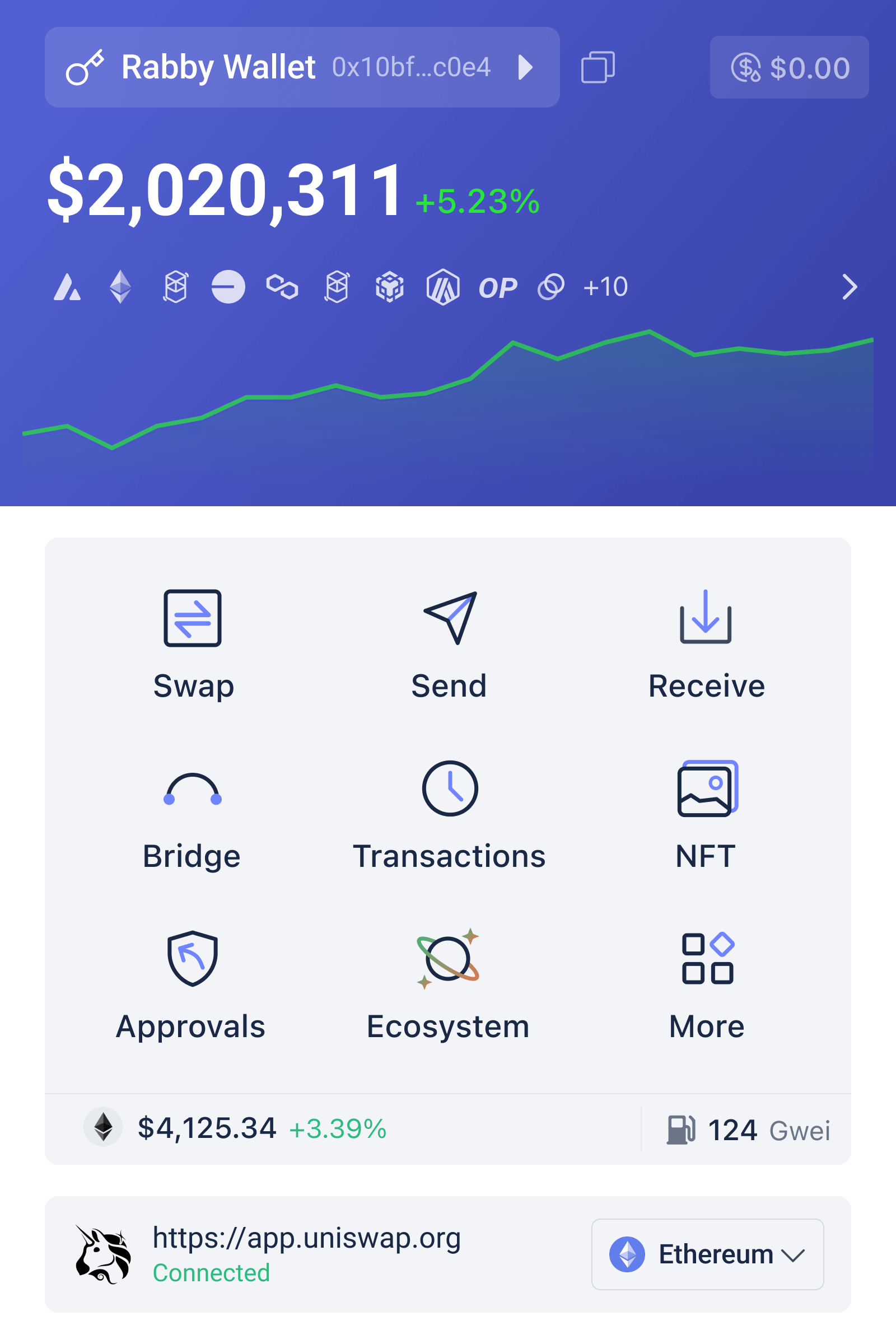
What Rabby changes in the wallet experience
Traditional wallet interfaces often present a transaction as a technical request: a contract address, a method name, a gas estimate, and a button to sign. That information is useful to specialists, but it does not always answer the practical question a user has: “What will I own after this transaction, and what permission am I giving away?” Rabby’s transaction simulation is designed to address that gap. Before signing, it previews expected changes to token balances and highlights relevant contract or address risks.
This creates an important conceptual distinction. A wallet does not make a smart contract safe merely by displaying a warning. Instead, it can improve the quality of the user’s decision by exposing information that would otherwise remain difficult to interpret. The simulation is best understood as a decision aid, not as an insurance policy. Results depend on the simulation environment, the contract’s behavior, the chosen route, and the possibility that blockchain state changes before the transaction is mined.
Rabby also includes a security engine that checks addresses and contracts for indicators such as phishing, known exploits, and potentially dangerous unlimited token approvals. An approval is not a transfer itself; it grants a contract permission to move specified tokens later. That distinction is frequently misunderstood. A warning about an infinite approval is therefore not necessarily proof that a protocol is malicious, but it signals that the permission may be broader or longer-lasting than necessary.
Why multi-chain support is more than a long network list
Rabby supports more than 140 EVM-compatible networks, including Ethereum, Polygon, Arbitrum, Optimism, Avalanche, Base, and BNB Chain. The practical benefit is not simply access. It is the reduction of network-management errors. When a decentralised application requests a particular chain, Rabby can identify the required network and switch automatically, avoiding one common source of failed or misdirected transactions.
Yet automation has a boundary. A wallet can select the technically correct network while the user still chooses the wrong application, asset, or contract. Multi-chain convenience can also encourage fragmented liquidity and more complicated records for accounting and tax purposes. German users who report crypto activity should not assume that a wallet’s unified interface creates a unified tax position. Transaction history, acquisition costs, fees, and transfers may still need separate reconstruction.
The integrated swap function adds another layer. Rabby can scan decentralised exchange routes, including venues such as Uniswap and 1inch, to seek competitive pricing and lower slippage. Slippage is the difference between the expected and executed price, often caused by market movement or insufficient liquidity. A route with the best quoted price is not automatically the best economic choice: gas costs, execution risk, price impact, bridge exposure, and token quality also matter.
For cross-chain transfers, Rabby integrates bridge infrastructure such as LI.FI directly into the interface. This can make moving assets between networks more coherent, but it does not remove bridge risk. A bridge or route may involve multiple contracts, liquidity providers, and execution steps. The correct mental model is not “one transfer,” but “a sequence of dependent operations.” Simulation and warnings can improve visibility, while the underlying protocol risks remain.
Gas Account and the trade-off between convenience and control
Rabby’s Gas Account feature allows users to pay network fees with stablecoins such as USDC, including in situations where they do not hold the native token of the relevant chain. This solves a familiar operational problem: a user may possess valuable assets on a network but lack the small amount of ETH, MATIC, or another native asset needed to transact.
Paying gas in a stablecoin changes the user experience, not the underlying economics. Someone still pays a network fee, and the mechanism enabling the conversion or sponsorship must operate correctly. Users should also distinguish between a stablecoin balance and a fee balance: having USDC does not mean every network or transaction can necessarily be covered under every condition. Availability, supported routes, and service dependencies matter.
This illustrates a broader principle for evaluating DeFi wallets. Every convenience feature relocates complexity; it rarely eliminates it. A gas account hides the need to acquire native tokens, while an aggregator hides route selection and a bridge interface hides coordination across protocols. That can be beneficial for ordinary use, but advanced users should retain the ability to inspect the underlying transaction path.
Rabby compared with other wallet approaches
Rabby and MetaMask
MetaMask remains a widely recognised general-purpose wallet and is deeply integrated across the EVM ecosystem. Its familiarity, broad dApp compatibility, and established workflow can be valuable, particularly for users who prefer a conventional signing interface. Rabby differentiates itself by making transaction simulation, risk signalling, automatic network selection, and multi-chain DeFi navigation more central to the experience. The trade-off is that a more information-rich interface may feel less minimal to users who only perform occasional transfers.
Rabby and hardware wallets
A hardware wallet such as Ledger, Trezor, or OneKey protects key material through a dedicated signing device. Rabby can work with these devices, combining a more informative transaction review layer with stronger key-isolation practices. This is often a sensible arrangement for larger balances: Rabby interprets the transaction, while the hardware wallet retains control over the signing key.
However, hardware signing does not validate a contract’s economic purpose. A user can still approve a malicious or overly broad action on a secure device. Physical key protection addresses one threat category; simulation and careful review address another. They are complementary controls, not substitutes.
Rabby and smart-contract or account-abstraction wallets
Smart-contract wallets can provide programmable recovery, spending limits, social recovery, or more flexible transaction policies. They may be attractive for teams and users who want account-level controls rather than a single private-key model. Rabby’s main strength is different: it is a browser-based, non-custodial interface that emphasises transparent review across EVM applications. A user choosing between these models should ask whether the priority is transaction visibility, programmable account governance, or maximum compatibility with existing dApps.
Security: what Rabby can and cannot protect
Rabby stores private keys locally under a non-custodial model and does not transmit them to Rabby’s servers. Its open-source architecture, released under the MIT licence, also allows community inspection of the software. These are meaningful design properties, but they do not eliminate endpoint risk. Malware, browser compromise, fake wallet downloads, weak backups, and phishing can all undermine a sound wallet architecture.
Users should install software only from trusted distribution channels, verify the intended domain before entering a seed phrase, and separate everyday activity from long-term holdings where practical. A hardware wallet is particularly relevant for substantial funds. Seed phrases should never be entered into a website, support form, or unsolicited recovery tool.
Rabby’s backend independence is another useful boundary to understand. The wallet does not itself create or alter the user’s blockchain transactions; it acts as an interface and checking layer, while core signing can remain available if Rabby services experience an outage. Some information services, simulations, route discovery, and risk signals may nevertheless depend on external data or infrastructure. Offline signing capability should not be confused with uninterrupted availability of every convenience feature.
A decision framework for DeFi users
Rabby is especially suitable for users who regularly interact with several EVM chains, compare swaps, use bridges, or want a clearer pre-signing review. Before approving a transaction, a reusable four-question check is more valuable than any wallet brand: Is the network correct? Are the assets leaving and arriving as expected? What permissions are being granted? Does the route involve an additional bridge, aggregator, or service dependency?
Those questions turn simulation into a habit rather than a decorative feature. If the displayed result differs from the intended outcome, stop. If an approval is broader than necessary, investigate whether a more limited allowance is available. If a bridge transaction produces an unexpected intermediate asset or contract interaction, treat the discrepancy as a reason to research, not as a minor interface detail.
Rabby Points, earned through activities such as swaps, gas top-ups, or referrals, may add a loyalty dimension. Such rewards should not determine protocol choice. Incentives can encourage activity, while the user bears the economic and security consequences of that activity. A point system is therefore best treated as secondary to route quality, contract reputation, fees, custody practices, and risk tolerance.
What to watch next
The recent Chrome Web Store description presents Rabby as an open-source browser wallet for Ethereum and EVM networks, designed around a smooth multi-chain DeFi experience and protection features. The direction is clear: wallets are evolving from passive key managers into transaction interpretation layers. If this trend continues, the competitive question will be less about how many networks a wallet lists and more about how accurately and intelligibly it explains composite actions.
The unresolved issue is verification. Simulations and scanners can make a transaction easier to understand, but they rely on available data and cannot foresee every economic, governance, or protocol failure. The strongest future wallet design would therefore combine readable previews with granular permissions, hardware signing, transparent route disclosure, and clear explanations of uncertainty.
Frequently asked questions
Is Rabby a custodial wallet?
No. Rabby is designed as a non-custodial wallet: private keys are stored locally on the user’s device rather than being handed to Rabby. The user remains responsible for seed-phrase security, device protection, backups, and transaction approval.
Does transaction simulation guarantee that a DeFi transaction is safe?
No. Simulation can reveal expected balance changes and highlight known risks, but it is a pre-execution analysis. Contract logic, blockchain state, route dependencies, phishing, and economic risks can still produce losses. Users should treat the result as evidence for a decision, not as a guarantee.
Can Rabby replace a hardware wallet?
For some users, Rabby may be sufficient for limited, routine activity. For larger balances or long-term holdings, pairing Rabby with a Ledger, Trezor, or OneKey device provides an additional layer of key protection. The wallet interface and the signing device solve different security problems.
Where can a user learn more about the Rabby wallet extension?
A reader evaluating installation and supported workflows can review the rabby extension information, then verify the official distribution channel and check the requested permissions before use.